
live · Cold Chain
The cold room that keeps its own record.
Cold rooms, freezers and pharma stores, each with its band. Every stretch outside it becomes a record — when, how warm, for how long, the door, the defrost, who acknowledged it, the reason, who signed. The inspector gets the record as one download.
RuleA defrost within its allowance is neither an alarm nor an excursion; one past its allowance is.
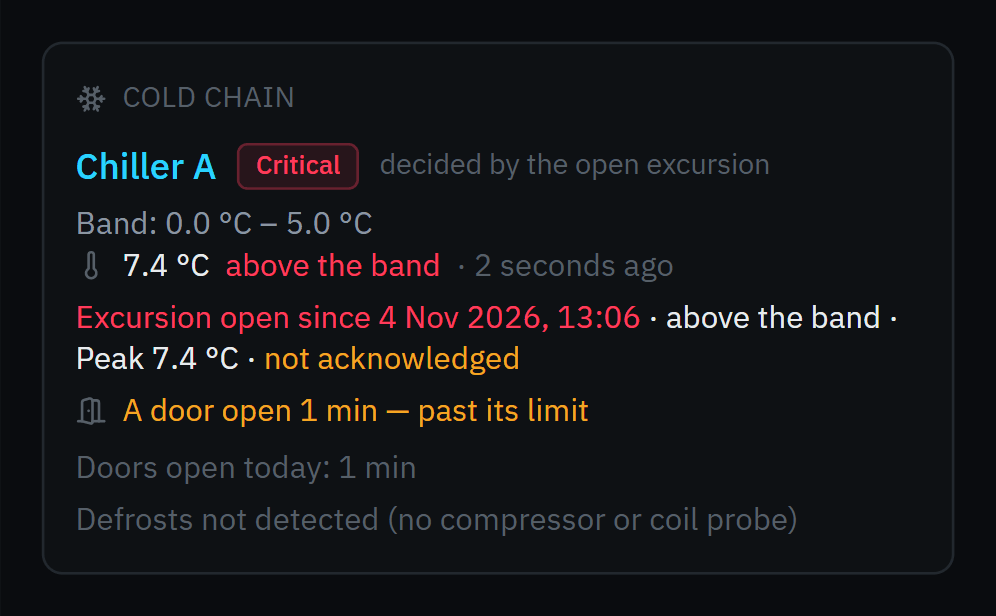
- 09:50:16Chiller A is above its band: 7.4 °C at its warmest, for 1 min
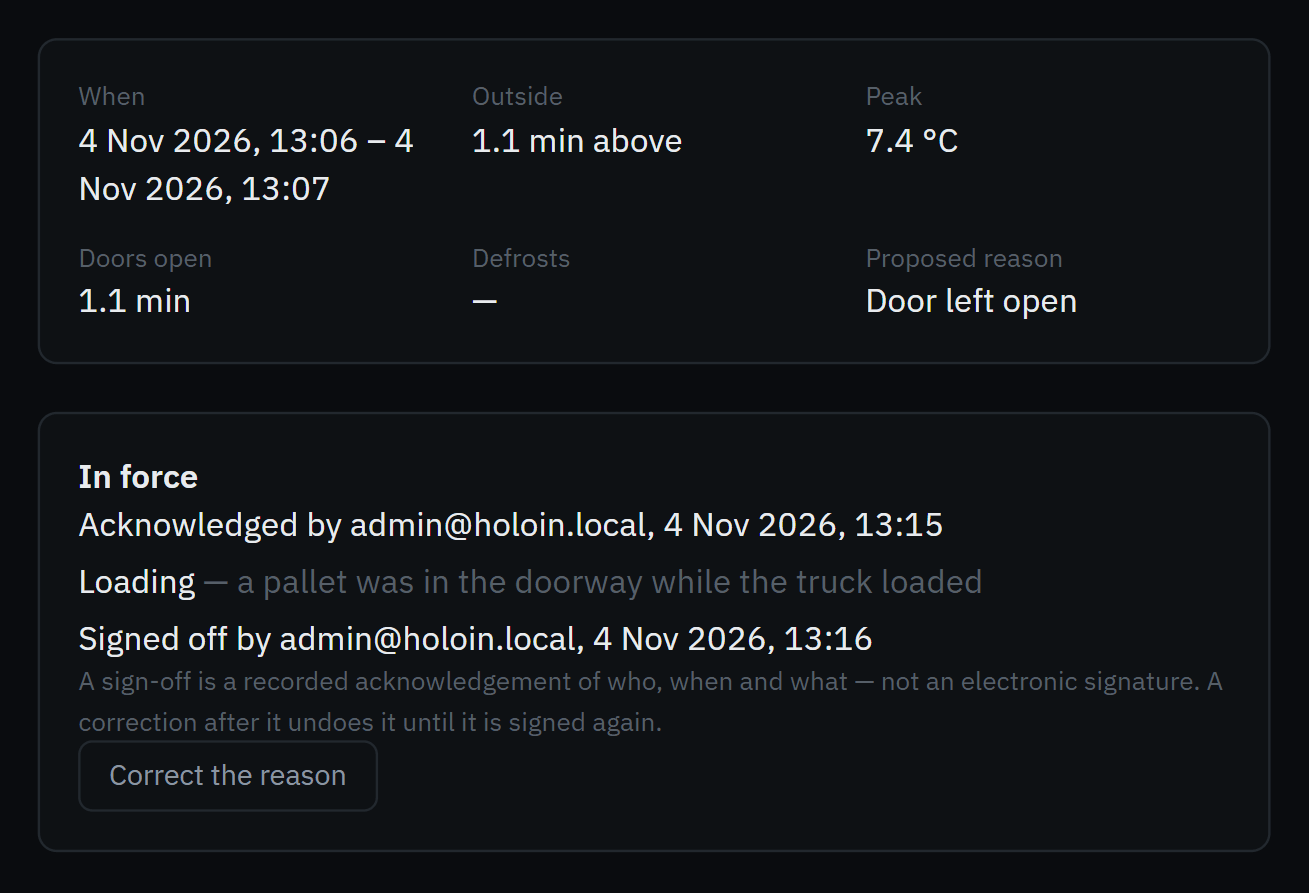
- reasonloading · proposed door left open, corrected by a person
- signedSigned off · on the record
In the operator’s words.
Each excursion is recorded with the door’s state and any defrost during it; the likely cause is proposed (a door left open, a defrost run long), and a person gives the reason.
A defrost within its allowance is neither an alarm nor an excursion; one past its allowance is.
Readings that arrive late are history: stored, counted, never alarmed after the fact.
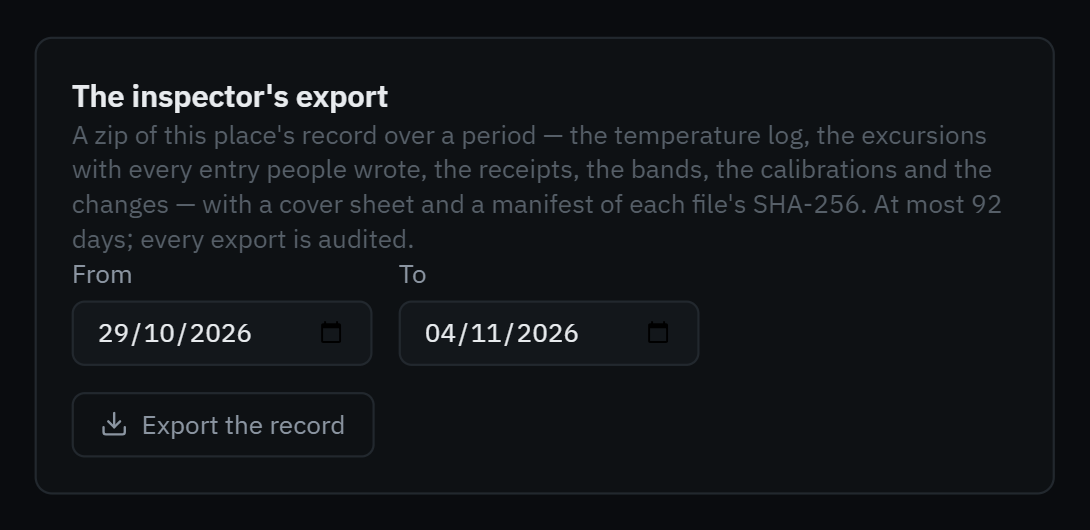
One export per place and period: every reading, every excursion with its reasons and sign-off, every band and probe change, the mapping in force, with a fingerprint per file.
A mapping study with placed loggers finds the hot and cold spots and records where the monitor was put, signed.
From the record.
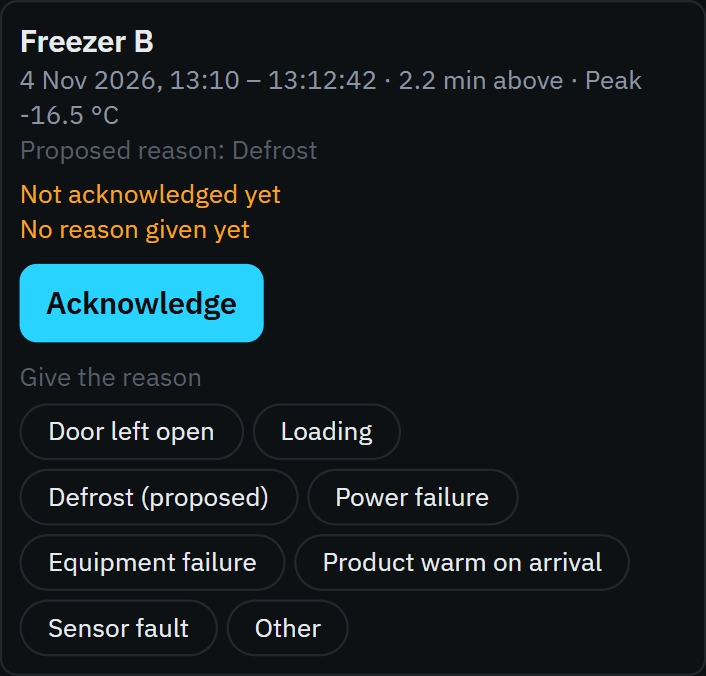
At Frostmere Cold Store, Chiller A went above its band at 09:50:16 — 7.4 °C at its warmest, for 1 min. The door had been open 66 s. HOLOIN raised ‘Chiller A is above its band: 7.4 °C at its warmest, for 1 min’ and proposed the reason door left open. Freezer B’s defrost ran past its allowance: ‘A defrost at Freezer B has run past its allowance (1 min so far)’, reason proposed defrost. Four readings that arrived late after a gap were kept as history and alarmed nothing. The excursion was acknowledged, its reason corrected to loading, signed off, the sign-off undone and signed again — all on the record. The export for Chiller A: 9 files, every fingerprint matching its manifest. The mapping study found the cold spot door side, middle shelf and the hot spot back wall, top shelf; the monitor sits where the study chose.
What you actually want to know.
Do I have to install anything?
On your own servers, in the same installation as everything else: a cold place is a room of a building, with its band.
What do I need?
A temperature probe in each place that reaches HOLOIN by any way in — a LoRaWAN logger, a controller on the building network.
- Decentlab DL-SHT35 air temperature and humidity sensor verified (simulated)
What does it cost?
Per installation, per year, by device tier: on request. No per-seat fees; every user is included.
Who do I call?
Hours, channel and response time: on request. Every installation can produce a support bundle on demand, a readable archive with no personal data or secrets, which your IT team can check before it goes to us.
Place the probes, set each place’s band, alarm delay and defrost allowance, enter the fixed reasons your site uses. The first excursion appears as a record waiting for its reason.
- A record, not a certificate: HOLOIN keeps what the rule asks you to keep; whether it satisfies a given inspector is between you and the inspector.
- Vehicle compartments (reefers) are not in this release.
- Not a controller: HOLOIN reads the probes and never changes a setpoint or a defrost cycle.