
live · Smart factory
For the plant manager who reads machine states off a clipboard.
It reads your machines. It never writes.
Every machine on the floor read in its own protocol, into the same twin, alarms and work orders as everything else you run.
RuleEvery state from the machine’s own protocol; OEE as A × P × Q with its time elements shown; nothing written back.
- 00:38:52Reason entered by the operator · on the phone
- starvedPRESS-5 Press · derived from the line’s flow
- refused4 write attempts · each refused by the factory program
In the operator’s words.
Today: a reason sheet on a clipboard — typed up after the shift.
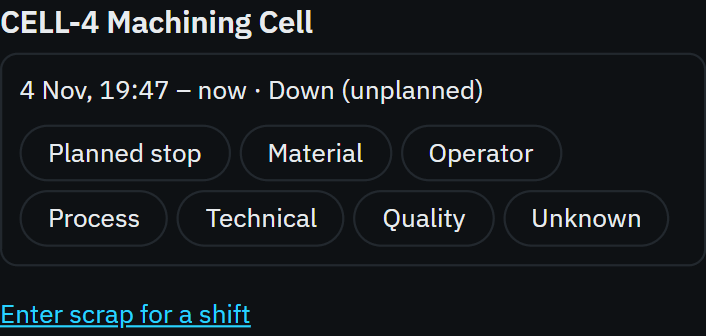
A stop longer than your threshold asks the operator for its reason on the phone, offline if it must. Seven top-level reasons no site can edit, and the sub-reasons you own. “Unknown” is counted, never buried: reason coverage is a figure on every shift.
Today: an OEE tool — its own sensors, its own cloud.
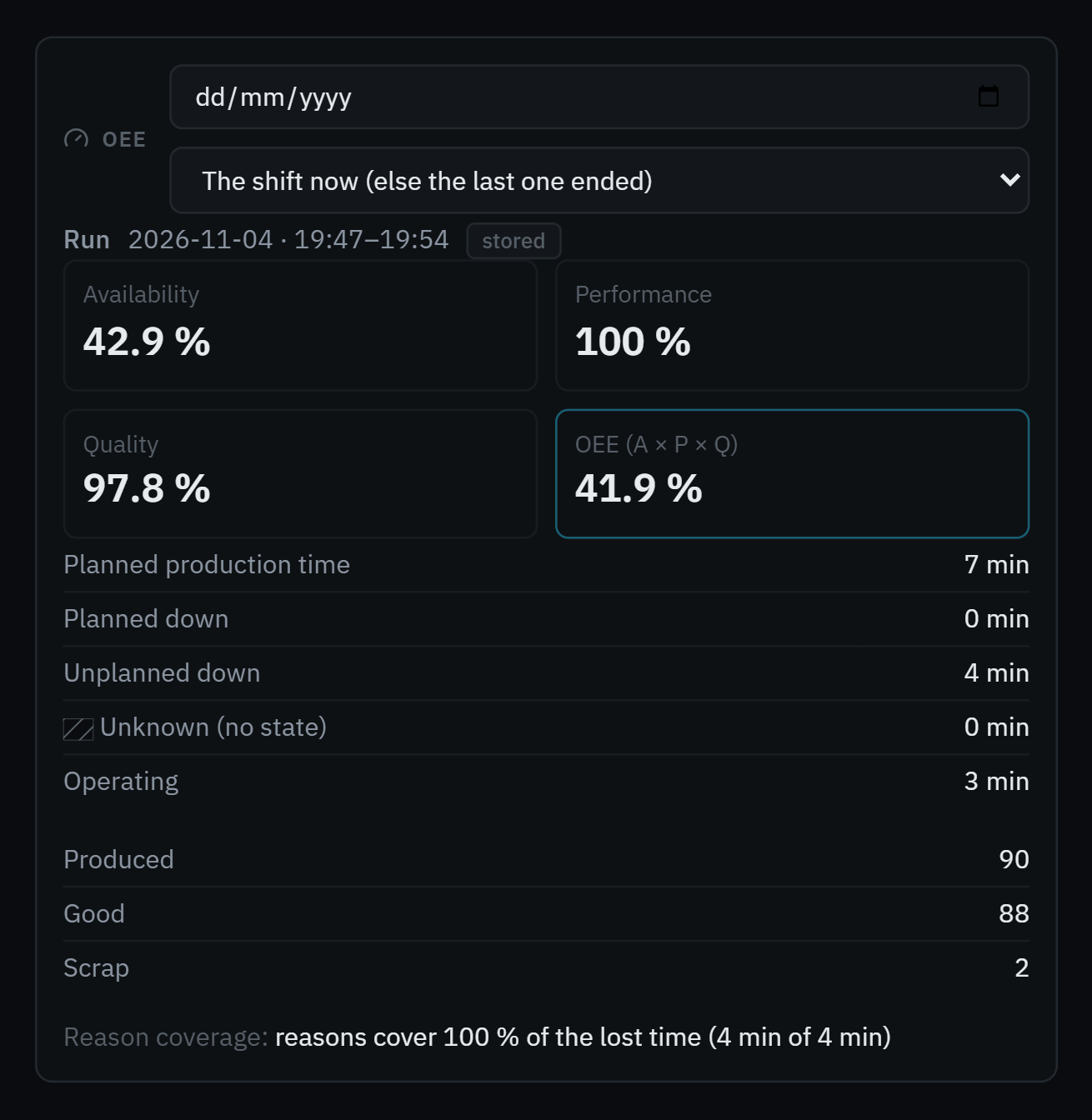
Availability × Performance × Quality per machine per shift, rolled up to line, area and factory, with the time elements shown: planned time, planned and unplanned stops, operating time, produced, good, scrap. A standard that’s too slow is capped and reported. Quality is measured only where something counts the rejects; otherwise the shift says so, and never shows 100 %.
Today: a maintenance system — stops retyped as tickets.
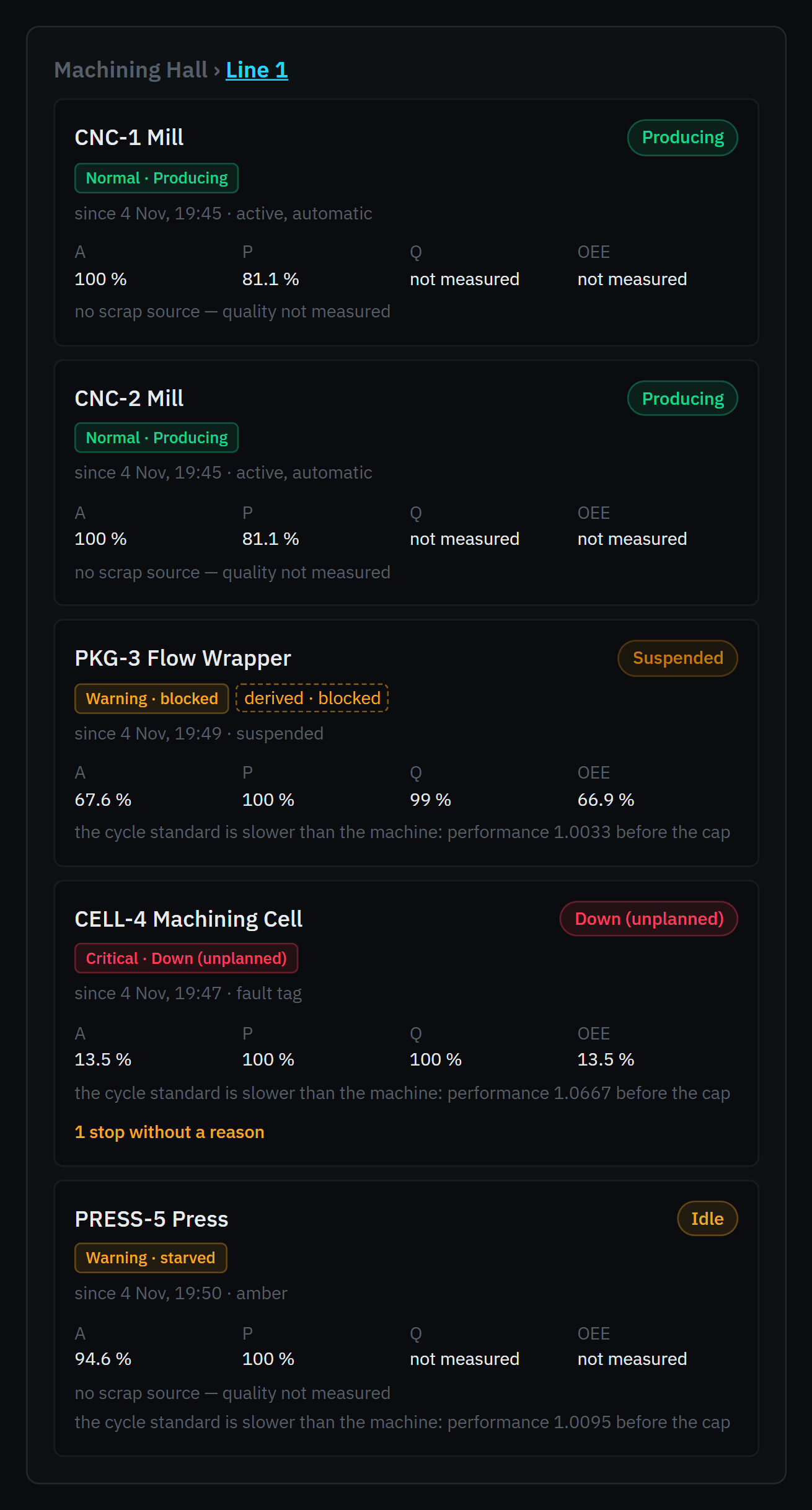
Starved and blocked are derived from the line’s flow and the buffers between machines, and labelled derived. A neighbour’s pause shorter than the machine’s own cycle changes nothing.
Today: each machine-builder’s portal — one login per maker.
The factory program on your plant network is built from the read halves of each driver: the code to write isn’t in its package. A test on every release sends it every kind of write and passes only if each is refused and the machine received reads only. Its read-only statement is generated from that code and ships inside the package.
From the demo run. 4 write attempts, one per protocol, every one refused by the factory program.
From the record.
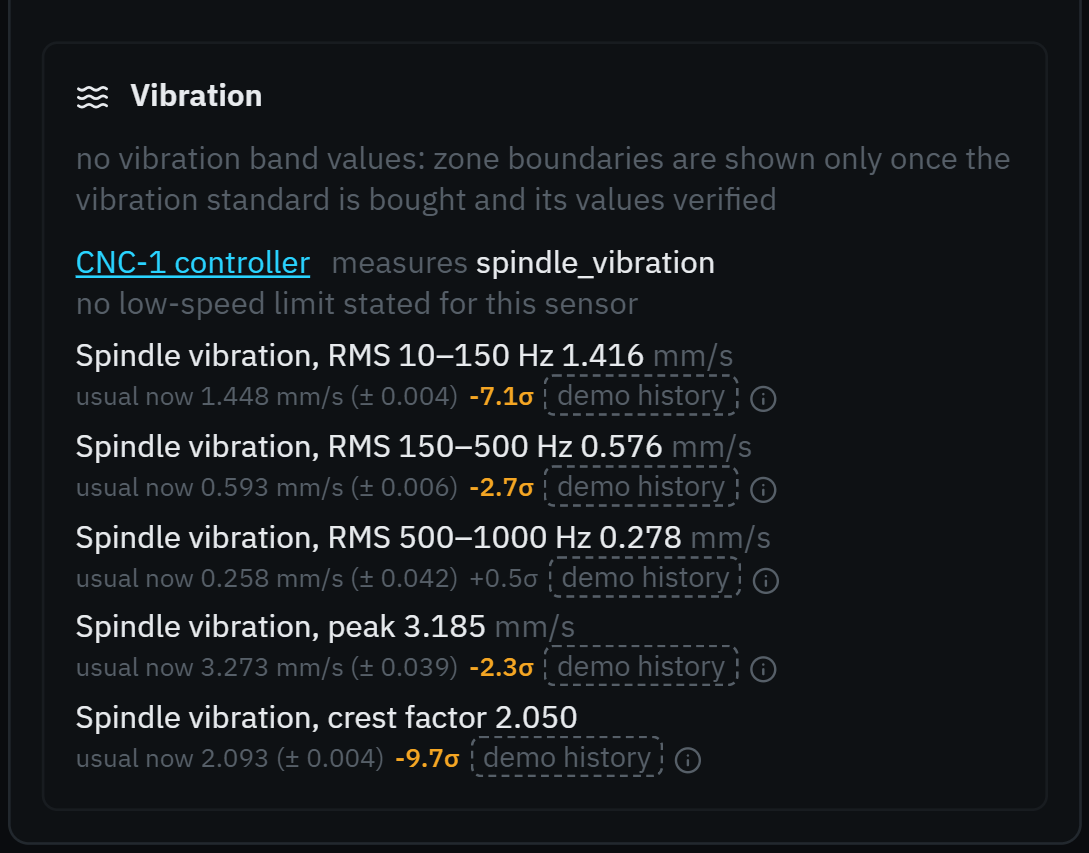
A line is its machines in flow order, the buffers between them, the bottleneck you named, and the shift they run in. On Line 1, CELL-4 Machining Cell stopped 4 min; the operator entered technical / Spindle drive fault at 00:38:52, on the phone. The machines behind it — PRESS-5 Press — were starved, each derived from the line’s flow. The shift’s OEE was 41.9 % (A 42.9 · P 100 · Q 97.8); the line’s figure is its bottleneck’s, the machine a person named. CNC-1 Mill’s bearing read 0.28 mm/s RMS — a reading, not yet judged. 4 write attempts, one per protocol, every one refused by the factory program.
What you actually want to know.
Do I have to install anything?
No. We run HOLOIN for you on a dedicated server in the country you choose, never shared with another company, and you can take it with you. If you have your own servers, install it there instead; same product.
You supply one Linux server with Docker, a place on the plant network for the factory program, connecting out, and the ports your IT opens — the install guide lists them. One install bundle carries what a plant needs.
What do I need?
Machines that speak one of the protocols the factory program reads, or a retrofit kit for one that doesn’t; a place on the plant network for the factory program, connecting out. The install guide lists the ports.
What does it cost?
Per installation, per year, by device tier: from US$15,000 a year for the platform and Smart Factory, up to 100 devices. The whole grid is on Pricing. No per-seat fees; every operator and supervisor is included.
Who do I call?
Hours, channel and response time: on request. Every installation can produce a support bundle on demand, a readable archive with no personal data or secrets, which your IT team can check before it goes to us.
The factory program goes on your plant network and connects out; the line appears. Name the bottleneck, set the stop threshold, and keep the sub-reasons you own.
- No command to a machine, ever: the factory module has no command type at all, and the factory program has no write primitive on any protocol.
- The factory program connects out to your installation; nothing connects in. Readings wait on its disk while the link is down and arrive in order, nothing lost.
- Keep the PLC’s own write protection on: it stays the authoritative control.
- Not an MES: orders and shifts come from your MES or ERP, or are entered; HOLOIN schedules nothing.
- A bearing rising against its own normal is a recommendation to inspect it, with the trend; never a zone before the standard is verified.
- The bottleneck, named by a person, and a recommendation when another machine limited the line more this week.
- A standard that’s too loose: a machine running faster than its standard on three of five shifts is a recommendation, with the standard cited.