
live · Buildings
For the facilities team that learns a room is bad from a complaint.
The ticket can’t lie about the room.
Comfort bands for every room, work orders on the technician’s phone, alarms that clear only when the air does — and it’s yours.
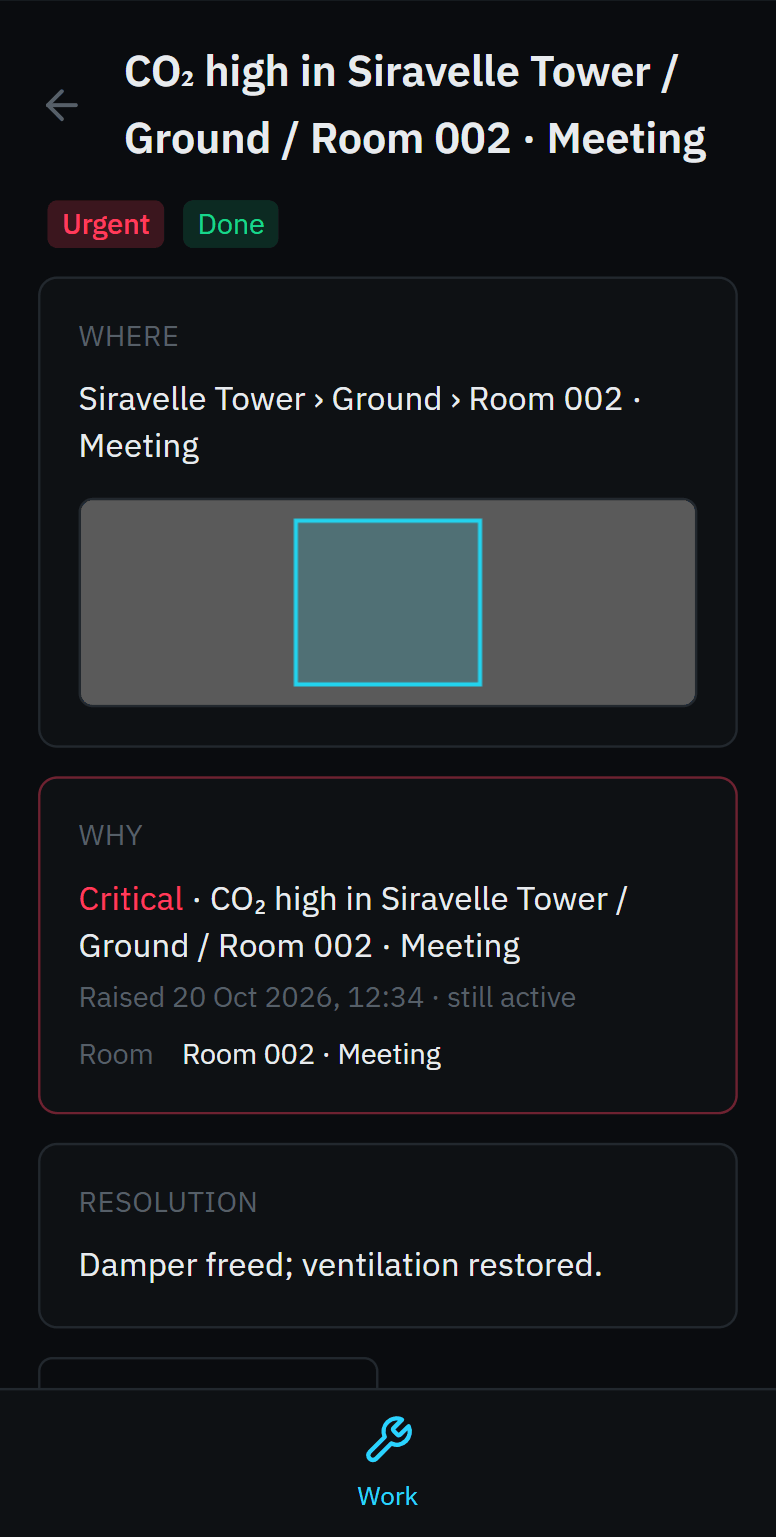
RuleCO₂ critical → work order: past 1.5 × the room’s ceiling for 5 minutes — critical alarm, a work order, the managers notified; shipped on for every company with a building.
- 20:27:13Alarm raised, critical
- 20:27:13Work order #23 opened and assigned · urgent, on the technician’s phone
- 20:27:27Work order closed by the technician
- 20:27:42Alarm cleared · by the reading
What a facilities manager actually hears.
Four sentences from the people who run buildings. Each one is answered below, with the screen that answers it.
Four problems, four screens, and the building in 3D.
Each answer below is something the product did in the demo run, shown on the screen where it did it.
Every room against its band. Out of the band is an alarm and a work order.
Each room carries its own limits for temperature and humidity and a ceiling for CO₂; a reading past one turns the room warning or critical. One rule ships switched on: CO₂ at its critical line, held five minutes, raises an alarm on the room and opens an urgent work order; a person assigns it. Alarms on the other lines are rules you set.
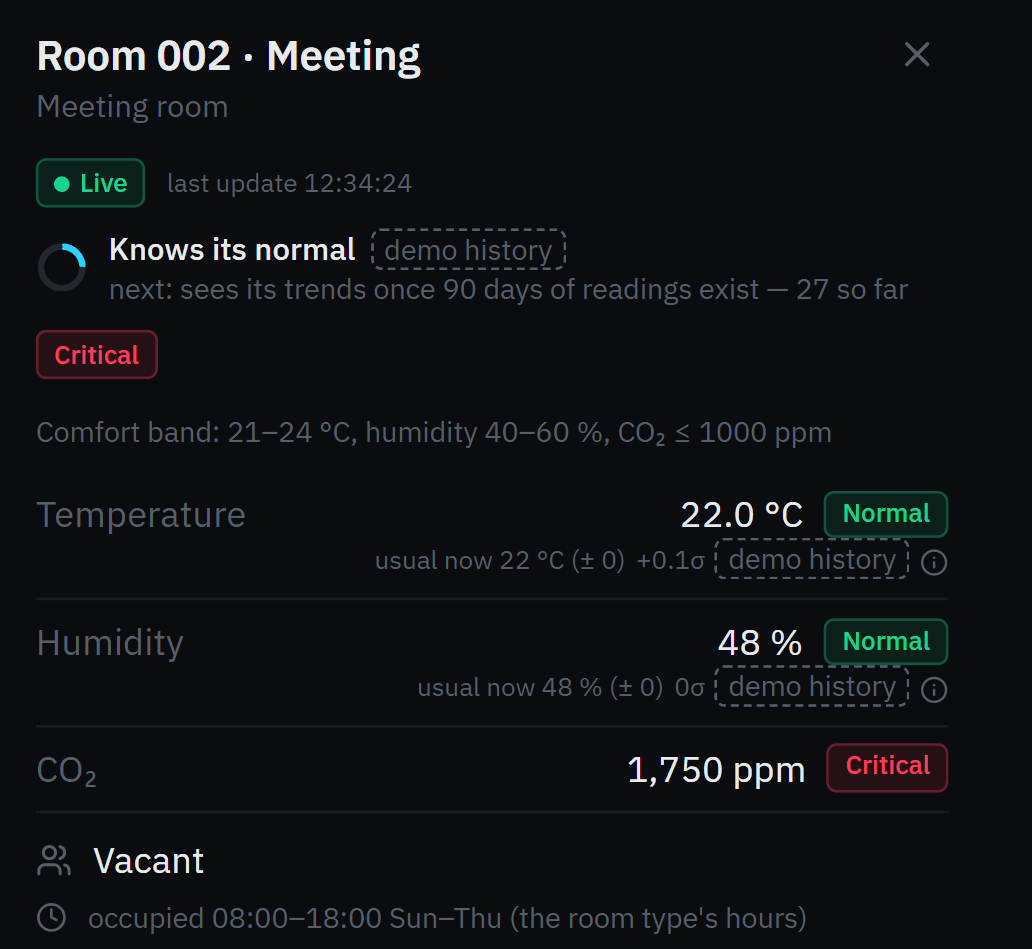
The alarm clears when the reading does, not when the ticket closes.
Closing the work order doesn’t clear the alarm; the reading coming back under the rule’s line does. Both moments stay on the work order’s timeline, each with its own time.
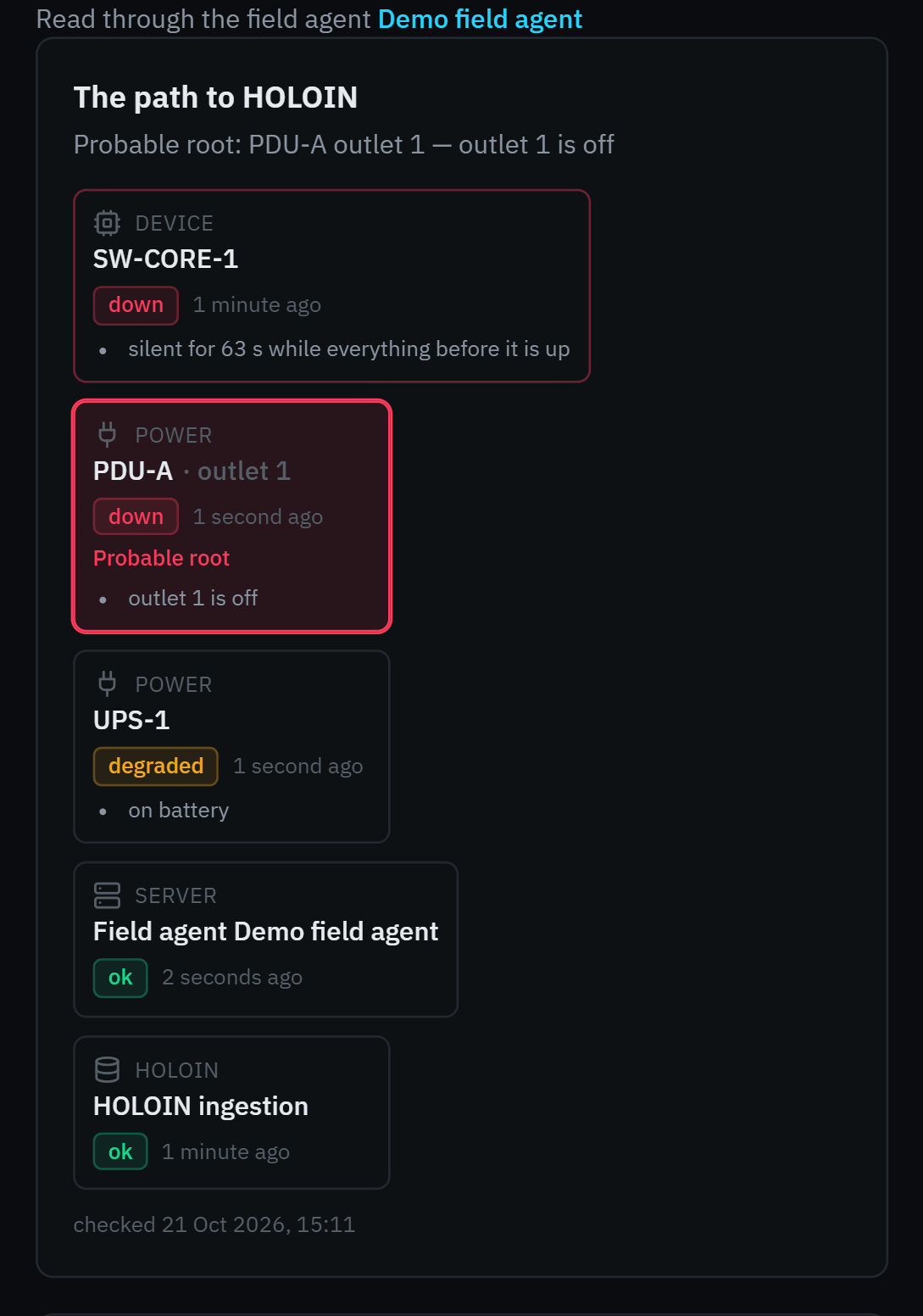
One alarm, on the outlet that cut the power.
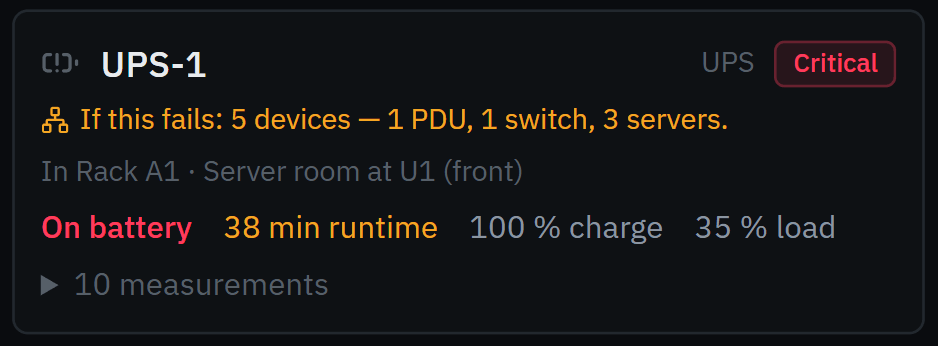
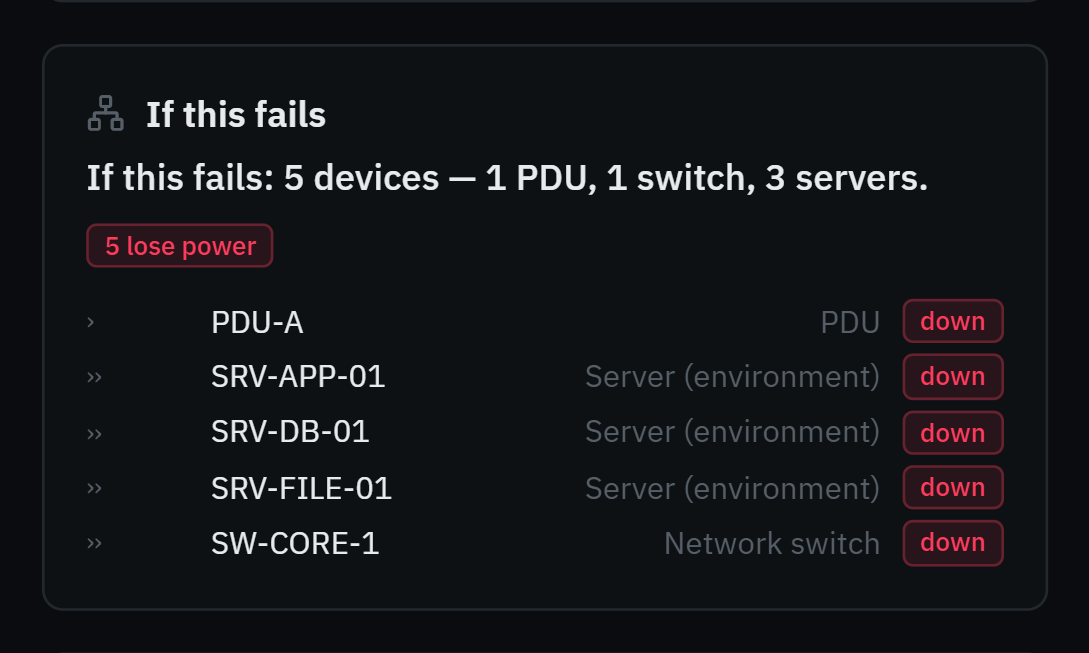
The server room’s UPS, PDU and switch are devices in the twin, with what powers and connects what. When a PDU outlet goes off, the switch and the servers behind it go silent together: after ten minutes of silence (thirty seconds in the demo) one alarm names the outlet, and their alarms are held back while it lasts.
The BMS stays. HOLOIN reads it.
The AHU’s points over BACnet, its trend logs read back as history. The BMS, mapped in — verified against a simulated BMS. HOLOIN reads the air handler mapped from the BMS; it never writes to it.
Every room, where it is.
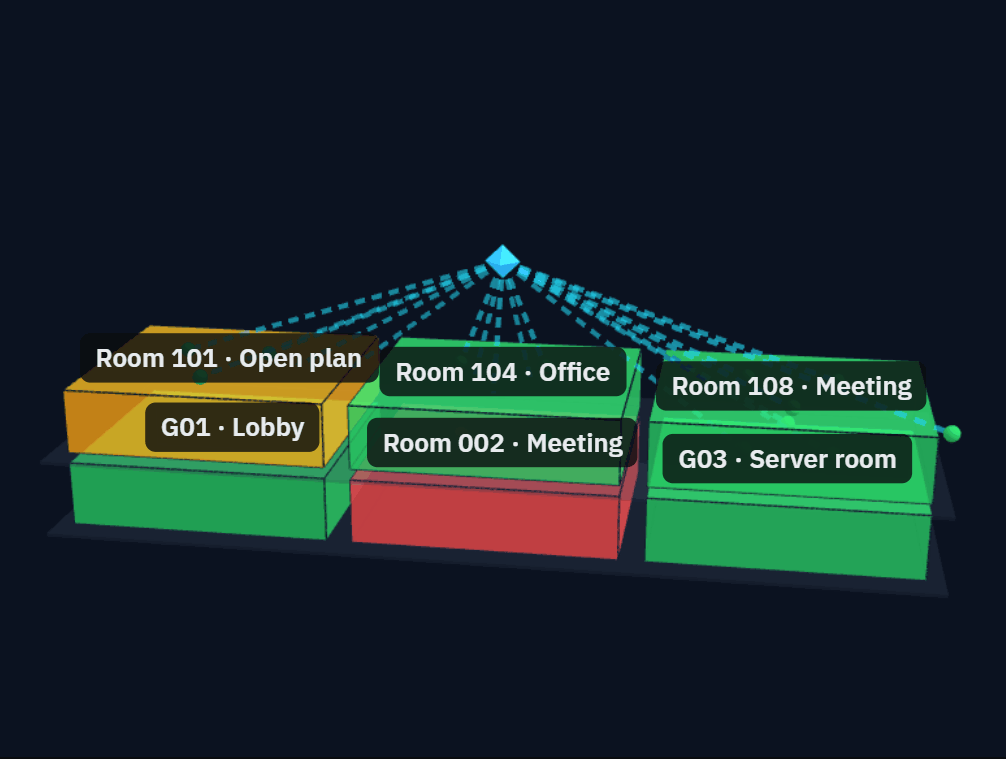
The building as floors and rooms in 3D, each room coloured by its live state. Click a room and its twin opens; the same rooms on a floor plan, or as a list.
And the rest of the day’s work
The building is the record. Everything attaches to it.
A building is floors and rooms. Each room carries its sensors, its bands and its hours, read over LoRaWAN through a gateway in the building, and its controllers through the Field Agent.
Temperature, humidity and CO₂ against the room’s band; light and noise reported.
Against the BMS schedule or the room type’s hours.
An alarm on the room they belong to.
The AHU’s and VAV’s points, from the BMS; the server room’s UPS, PDU and switches.
Opened by a rule you can read, or by a person.
Every reading of its sensors, and the room’s alarms and work orders.
Fewer complaints. Fewer tickets closed on rooms still out of band.
Stated as changes, not as numbers: your numbers are yours to measure, and Why it pays gives you the arithmetic.
- A stuffy room is found by the people in it.
- A ticket closed means the problem is gone.
- A UPS on battery fills the screen with alarms.
- The BMS, the IT monitor and the tickets live apart.
- Where a room is lives in someone’s head.
- A room’s CO₂ past its critical line is an alarm and a work order.
- The alarm clears only when the reading does.
- One alarm names the cause; the rest wait under it.
- One twin reads the BMS and the server room, and opens the work orders.
- Every room on a plan, a list, or in 3D, with its live state.
OT and IT, in one twin.
OT and IT, in one twin. The room’s sensors and the AHU over BACnet are the OT; the server room that keeps the building running — UPS, PDU, switch over SNMP, the servers pushing their own readings — is the IT. The wiring proposed from the IT team’s own asset database, applied after a person reviews it, and from the switches’ neighbour tables, each link confirmed by a person. Buildings also carry the 3D view: racks at their U, connections as lines, the data path pulsing on each reading.
OT · what is measured
Temperature, humidity, CO₂, light, noise against the room’s band; occupancy against its hours; doors, leaks; the AHU’s points over BACnet, read only, its trend logs read back as history; a room controller’s setpoint counts as done only when it reports the new value.
IT · what keeps it reporting
UPS, PDU and switches over SNMP; your monitoring’s alerts matched to the placed device; racks and cables from your asset database, read-only; the switches’ neighbour tables proposing links for you to confirm.
Buy the devices. Everything else comes inside.
One install bundle carries the servers a building needs. A gateway in the building and a Field Agent box on your OT network connect to your server; the rooms appear.
- One Linux server with Dockeryours, or one we run for you in the country you choose
- The sensors and controllersany model listed, or your own with a published map
- The ports your IT opensthe install guide lists them
- The Field Agent on the OT networkreads your controllers in their own protocols, each with its status on What’s inside
- The LoRaWAN network serverfor the room sensors, through a gateway in the building
- The database, the backups, the web entryone compose file, one address
- One scriptready in 2 min 42 s on the acceptance box (run 39194860273)
- Nightly backup, monthly restore drilla failed one is an alarm in the product
- Upgrade in placesame volumes, registrations and readings intact, proven on every release
- No telemetrythe bundled servers’ phone-home is off; CI fails if any container reaches out
The servers this kind of asset uses, each shown only when its acceptance run passed; statuses from the facts file.
Five systems, or one.
The same buildings, run the usual way. No names: the categories are what matters.
- A BMS front-end — setpoints and alarms in the controller maker’s words.
- A ticket tool — tickets closed on someone’s word.
- An IT monitoring tool — a page for every silent device.
- A room spreadsheet — bands and hours kept by whoever remembers.
- A 3D viewer — a model that doesn’t know the room is hot.
- The BMS mapped in — its points and alarms in the same twin.
- Work orders from rules — an alarm clears on the reading.
- The server room in the twin — one alarm names the cause.
- Every room with its bands and hours — live, on a plan or a list.
- The 3D view of the twin — each room in its live state.
Counted in devices. Never in people.
One licence per installation, per year, by device tier. A sensor or a controller is a device; a facilities manager’s login and a technician’s phone are not. Add facilities managers and technicians without a change to the bill.
The whole grid, every tier and every pack, is on Pricing — published, with what counts as a device and what is included.
- The platformUS$2,500
- The Buildings packUS$1,500
- Facilities managers and techniciansincluded
- The LoRaWAN network server, the phone appincluded
Your server. Your buildings’ data. Nothing phones home.
Not a policy page: each of these is a property of the software you can check on your own server.
One installation, yours
Installed from a bundle that carries everything it needs. Never a shared cloud: one installation per customer, or one your integrator runs for you, each client a company of its own.
PostgreSQL you own
Every reading, alarm and record in a database you administer. A nightly backup you can restore anywhere, drilled monthly.
Setpoints only on the controller’s word
A setpoint changes only by a rule a person wrote, a person’s command or an API key, and completes only when the controller reports the new value; every command is logged. The BMS’s own schedules and operators still act.
Nothing phones home
No telemetry in the product, none in the bundled servers. Proved with the network sealed on every release.
Your rules stay yours
Lines, rules, schedules and what the twin learned are text and arithmetic in your database; they leave with you.
An audit log that can’t be edited
Every change, by whom, from where — append-only in the database itself, for seven years, even for the database’s own administrator.
What you actually want to know.
Do I have to install anything?
No. We run HOLOIN for you on a dedicated server in the country you choose, never shared with another company, and you can take it with you. If you have your own servers, install it there instead; same product.
What do I need?
The room sensors and a LoRaWAN gateway in the building; for your controllers, the Field Agent on a small box on your OT network. The install guide lists the ports.
What does it cost?
Per installation, per year, by device tier: from US$4,000 a year for the platform and Buildings, up to 100 devices. The whole grid is on Pricing. No per-seat fees; every facilities manager and technician is included.
Who do I call?
Hours, channel and response time: on request. Every installation can produce a support bundle on demand, a readable archive with no personal data or secrets, which your IT team can check before it goes to us.
See it running on yours.
I’m responsible for the buildings
Fifteen minutes on a building like yours — no slides.
I install systems for clients
One installation per client, each a company of its own. The Field Agent on the OT network, the LoRaWAN network server inside, the ports in the install guide.
Start a partner conversation →